Cavity-based Photonic Interconnects for Neutral Atom Quantum Computers
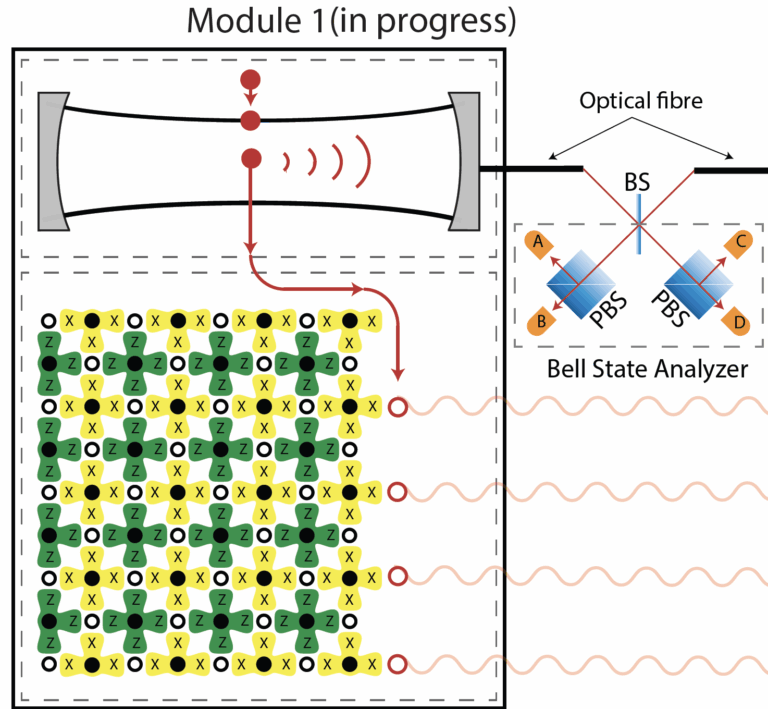
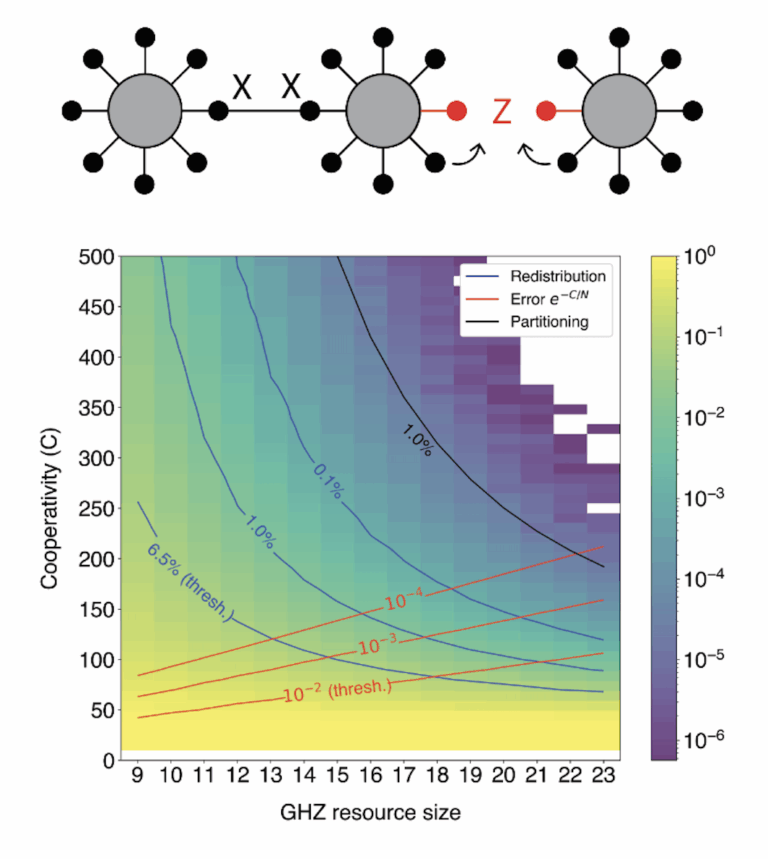
The goal of truly scalable modular fault-tolerant quantum computing is fast error-corrected quantum gates between remotely located logical qubits (see Fig. 1). A major challenge for any modular architecture is to communicate by distributing entanglement between modules with sufficiently low noise and high rate to satisfy the stringent requirements for quantum error correction. While many proposals have targeted small modules and required distributed entanglement errors below 1%, I showed during my postdoctoral studies that these requirements could be relaxed by a factor of 10 for modules large enough to house entire logical qubits [1,2]. As atom arrays are already this large, and with recent demonstrations of remote atom entanglement at this threshold [3], this high tolerance for noise brings error-corrected gates between modules within reach, with the primary remaining challenge being to develop fast methods of distributing entanglement between arrays.
- Ramette, J. Sinclair, N.P. Breuckmann, and V. Vuletić. “Fault-tolerant connection of error-corrected qubits with noisy links.” npj Quantum Inf 10, 58 (2024).
- Sinclair, J. Ramette, B. Grinkemeyer, D. Bluvstein, M.D. Lukin, V. Vuletić. “Fault-tolerant optical interconnects for neutral-atom arrays,” (2024) arXiv:2408.08955 [quant-ph].
Measurement-Based Quantum Computing with Programmable Atom Arrays
Entangled states are a resource for quantum computing and quantum sensing. We have proposed a new method of generating entangled states of multiple atoms which uses an optical cavity and achieves a fidelity which is exponentially better than similar prior methods [1]. The method is called ‘counterfactual carving’ and relies on no-jump evolution. We will integrate novel optical cavities with neutral atom arrays and explore creating entangled graph states of neutral atoms, which can be fused together to form cluster states for measurement-based quantum computing.
- Ramette, J. Sinclair, and V. Vuletić. “Counter-factual carving exponentially improves entangled-state fidelity,” (2024) arXiv: 2401.11407 [quant-ph].
